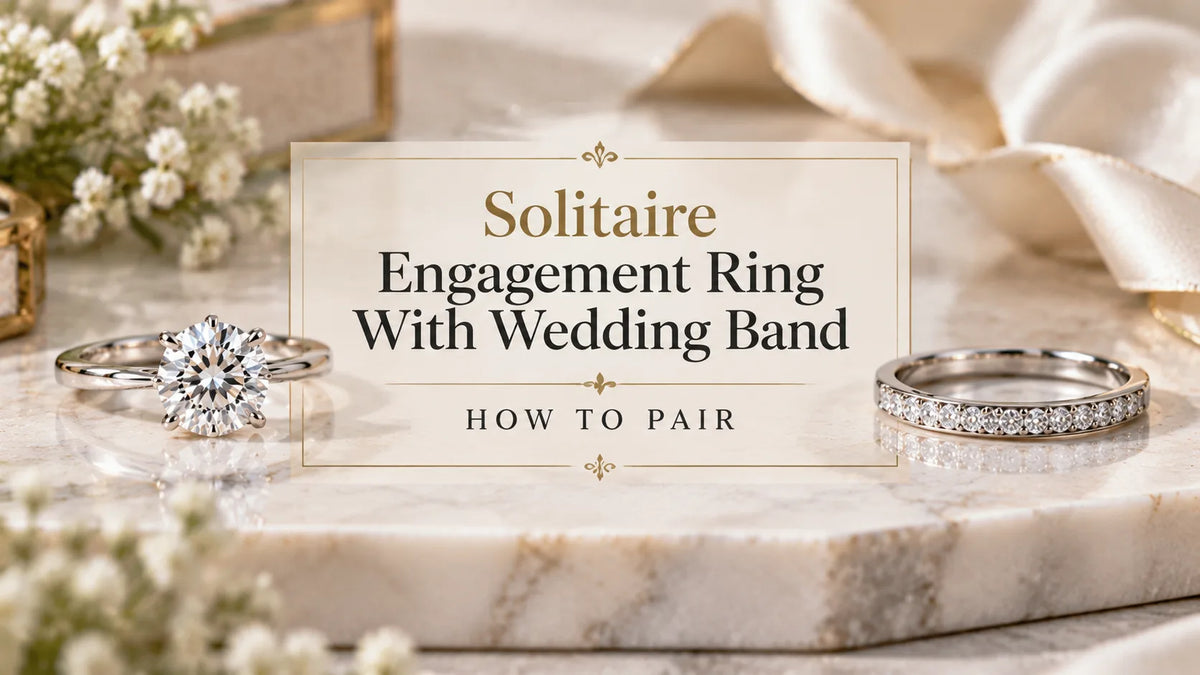
Solitaire Engagement Ring With Wedding Band: How to Pair
A solitaire engagement ring with a wedding band next to it is the most classic bridal pairing there is, and it's also the most forgiving. One stone does all the work, nothing crowds it, and your options open right up. Plain metal, pavé, baguette, half eternity, full eternity, and contour- they all sit well beside a solitaire. What actually narrows things down is your setting height, your stone shape, how wide each ring is, and whether you want the two touching or sitting slightly apart.
Here's how we walk couples through it at our bench, starting with a fit check you can run on your own.
Explore Our Collections
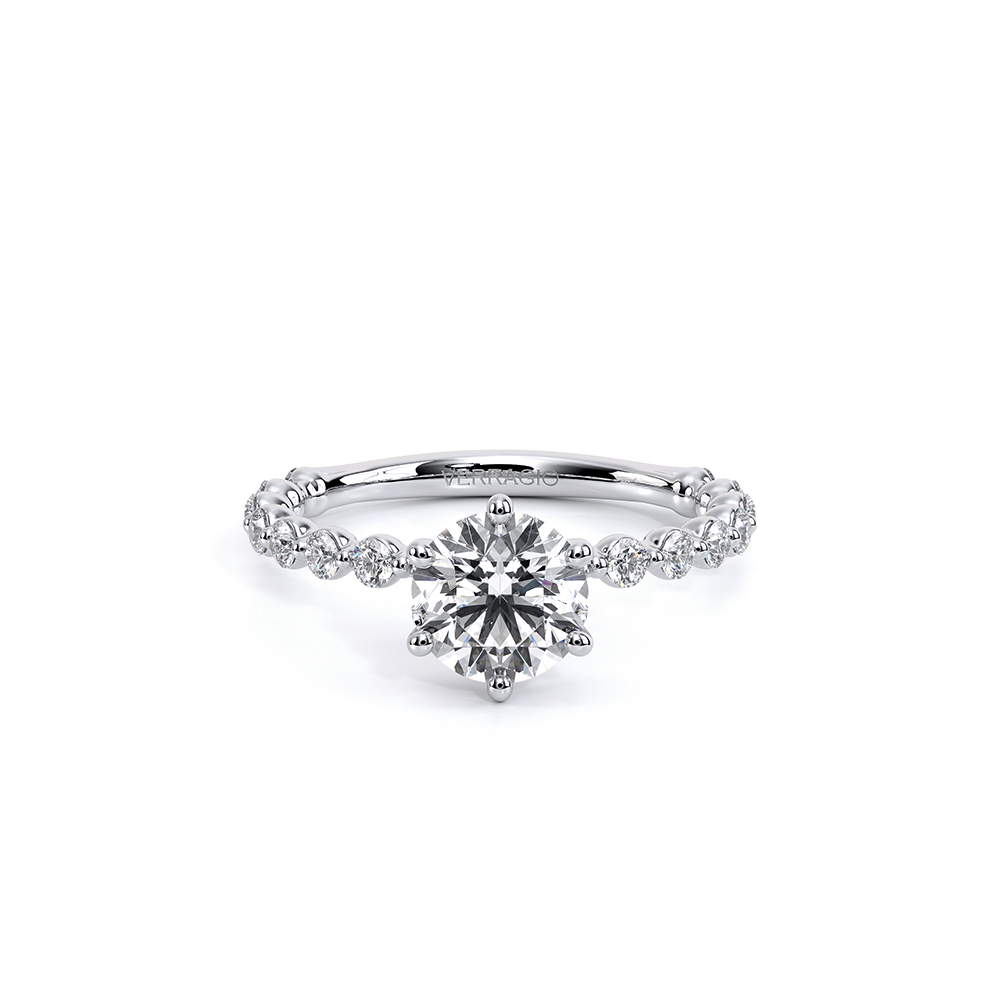
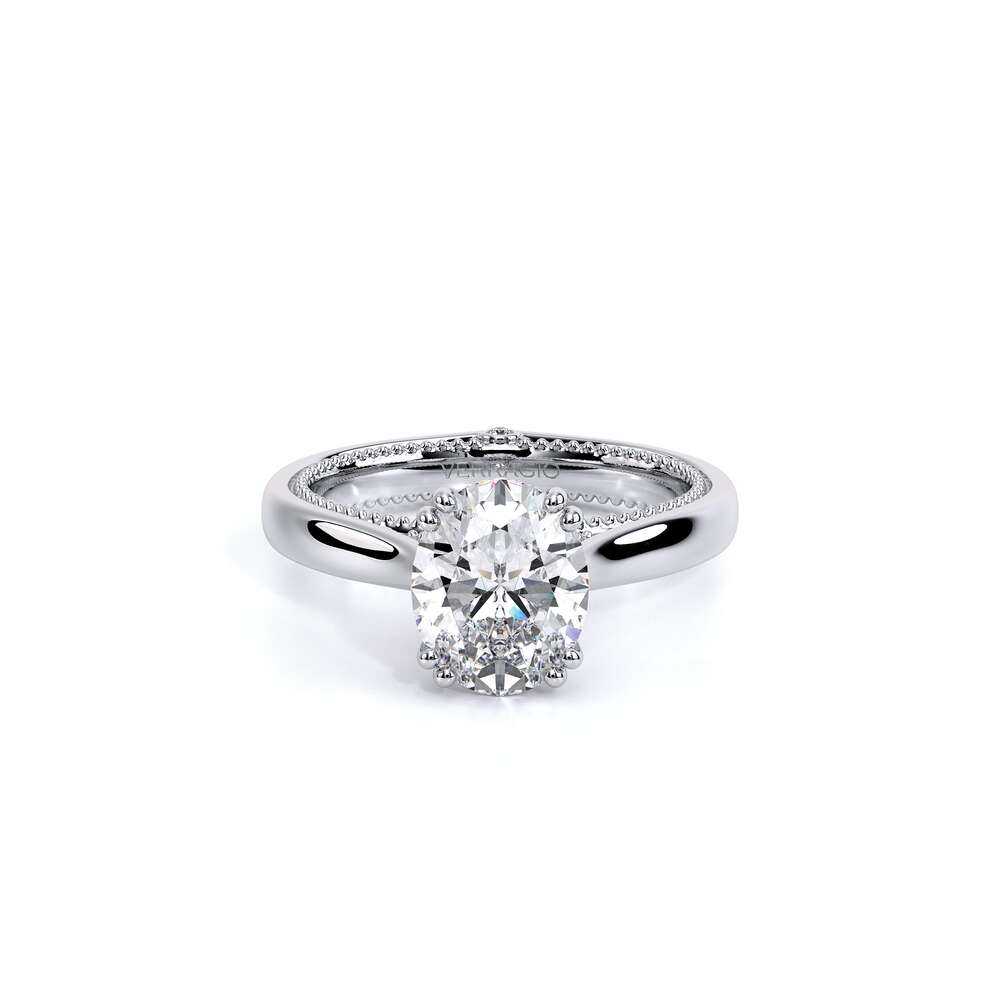
Table of contents
Key Takeaways
Check your engagement ring’s setting height first to determine whether a straight, curved, or contour wedding band will fit properly.
Match the band’s width and style to your solitaire for a balanced look, whether you prefer plain metal, pavé, baguette, or eternity designs.
Consider your center stone shape, as different shapes pair better with specific band profiles and designs.
Choose matching or mixed metals intentionally to create either a cohesive or distinctive two-tone look.
Think about comfort, sizing, and future stacking when selecting your wedding band, especially if you plan to add an anniversary band later.
Start With Your Ring's Profile, Not the Band
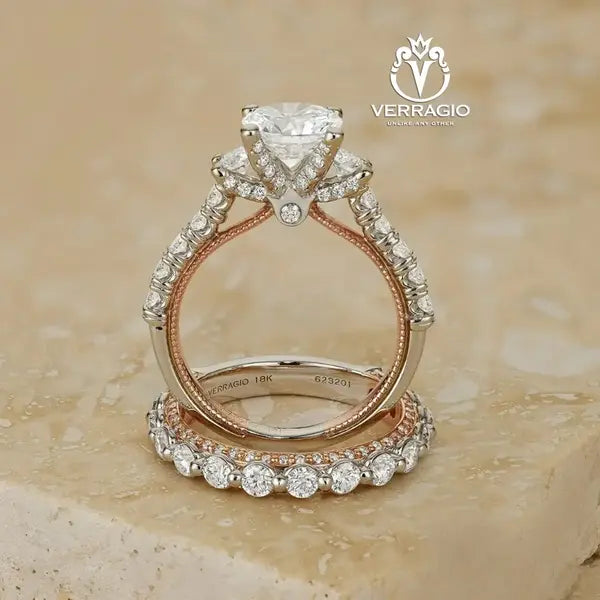
Most people start by browsing bands. Turn your ring sideways instead. That one angle tells you more in five seconds than an hour of scrolling will.
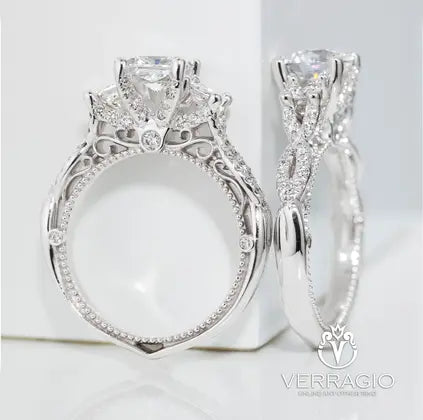
It all comes down to how much room sits under your center stone. A tall setting lifts the diamond up off the shank, so a straight band can slide right underneath. A low setting keeps the stone close to your finger, and a straight band will stop short and leave a visible wedge of daylight.

The 60-Second Fit Test
Try this at home, or at our counter with any band off the tray:
Set your engagement ring flat on a table and drop your eye down to table level.
Look at how much daylight sits under the stone.
Push a plain band up against the shank and see where it stops.
No light between the two? A straight band will work just fine.
Light coming through? Start looking at contour, open, or custom-fit designs.
Two things to keep in mind before you shop. A curve isn't a guarantee — the contour has to be cut for your specific setting to actually close that gap. And a little space isn't a flaw. Plenty of brides like that sliver of air between the rings, and it looks intentional as long as it stays even on both sides.
Band Styles Worth Trying Next to Your Solitaire
There's no single wedding band style that works with every solitaire engagement ring on every hand. What changes is how much light you want next to the stone, and how the band has to sit.
Here's one proportion rule we give everybody: keep your band about as wide as the shank of your engagement ring, or a hair narrower. A 1.5mm solitaire shank next to a 4mm band makes the engagement ring look skinny.
|
Band style |
The look |
Choose it when |
Fit note |
|---|---|---|---|
|
Plain metal |
Understated, no sparkle |
You want all eyes on the stone. |
Flat top, so it needs headroom beneath the head |
|
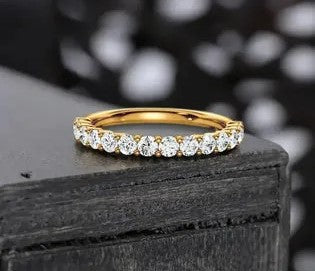
Pavé or shared prong |
A steady line of small stones |
You want brightness without bulk. |
Sits easily beside taller settings |
|
Baguette |
Long, linear flashes |
You like architectural detail. |
Straight edges expose uneven spacing. |
|
Half eternity |
Stones across the top only |
You want everyday practicality. |
The simplest style to size up or down |
|
Full eternity |
Sparkle right around the finger. |
You want the set to feel bigger. |
Resizing is limited, so measure carefully. |
|
Curved or contour |
Traces the shape of your ring |
Your setting sits low. |
The curve must be matched to your ring. |
Best Wedding Band Stacks for Solitaire Engagement Rings
If you want more than one band, here are the four combinations we fit most often.
One Plain Band, Worn Below
The simplest route, and where most brides start. A plain band in the same metal disappears into the set and hands the whole job to the solitaire. It also leaves you the most room to build on the stack later.
Twin Pavé Bands, One on Either Side
A matched pair of pavé bands frames the solitaire with even light above and below. This one's great with a round or cushion center stone in a white metal, where the sparkle stays consistent across all three rings.
Baguette Paired With a Flush-Set Band
Baguettes throw long, linear flashes instead of scattered sparkle. Put one next to a flush-set band, where the stones sit level with the metal, and you get structure with a vintage edge. Yellow gold really flatters this combo.
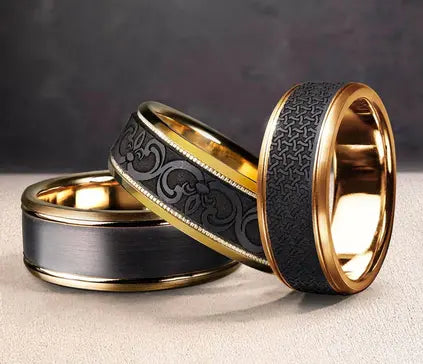
High Polish Against Texture
Don't want to add more diamonds? Let the finishes do the talking. A mirror-polished band next to a brushed or hammered one builds depth through surface alone. It's a quiet, modern look, and it holds up well with a larger stone.
Browse our stackable wedding bands to see how these look together.
How Your Center Stone Shape Changes the Pairing
Round: The most forgiving shape there is. Straight, curved, plain, and diamond—they all work, so let setting height and budget make the call.
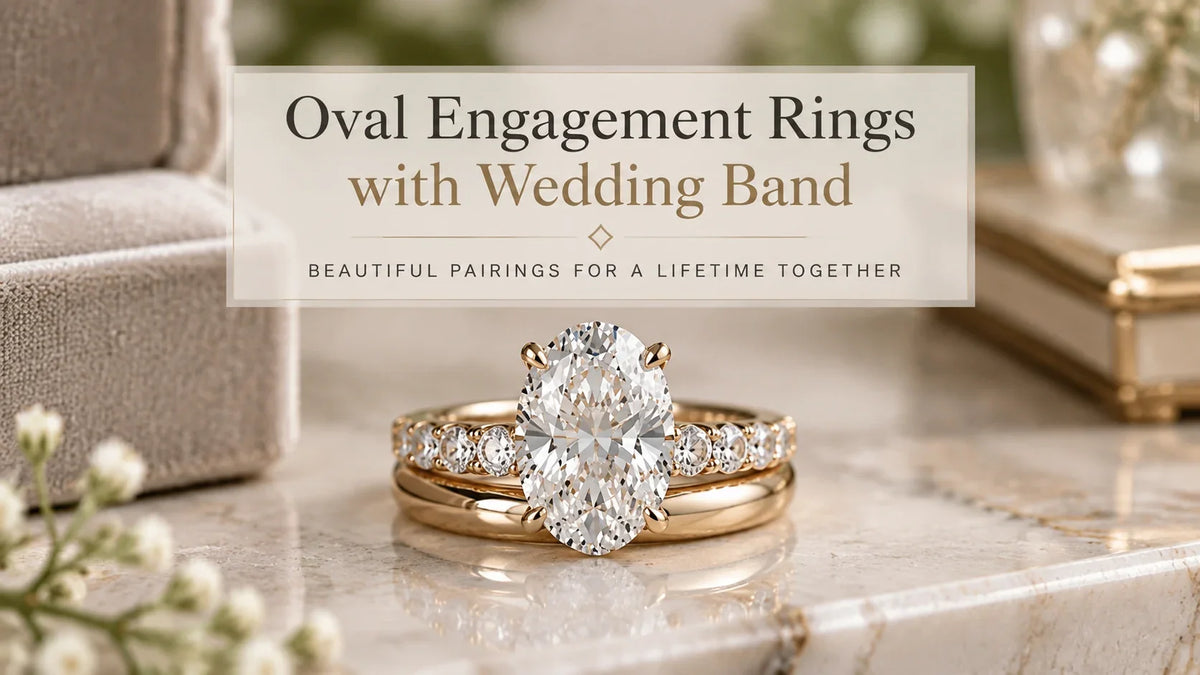
Oval: Pairing an oval solitaire engagement ring with a wedding band is a question about clearance, not about the oval itself. Lift the stone high enough, and a straight band slips right underneath. Keep it low, and a contour or a gentle V is worth it.
Pear and marquise: The point is what you're building around. Chevron and V shapes trace the outline and tuck the tip safely inside the curve. Our guide to pairing a pear-shaped engagement ring with a wedding band digs into this.
Emerald and ashtray: Step cuts run on clean, straight lines. Baguette and channel-set bands answer that geometry better than round pavé does.
Princess and radiant: Square outlines look sharpest against a straight band with squared edges. Skip the curve; it fights the shape.
Cushion: Soft corners go well with rounded bands and milgrain detail, which echo that gentle edge.

Staying in One Metal, or Deliberately Not
Keeping both rings in the same metal is the safe call, and the set will always look pulled together.
Two metals can look great, as long as the pairing looks like a choice. Echo that second tone somewhere else on your hand, and the combination reads as designed instead of mismatched.
One practical note from the bench: white gold carries a rhodium plating, and that plating wears down over a few years. Replace one ring and not the other, and a mixed set can drift out of tone. We handle replating in-house, and we'd suggest doing both rings at the same time.
You'll find our wedding bands in white, yellow, and rose gold in 14K and 18K, plus platinum.

Comfort, Sizing, and Leaving Room for Later
Two rings on one finger feel snugger than one. Slip both on before you settle on a size, and save that fitting for late afternoon, once your fingers have had a full day. Ask about comfort fit while you're there; that rounded inner edge makes a real difference on a wider band.
Sizing takes extra thought with a full eternity band. Stones circle the whole design, which leaves a jeweler almost nothing to work with if the size ever needs to change. Think your size might shift? Half eternity is the safer long-term bet.
It's also worth deciding now whether an anniversary band might join the stack down the road. Keeping that door open usually means picking something slimmer today.
As for stacking order, tradition puts the band nearest your palm with the engagement ring above it. That's a preference, not a rule, and we cover both approaches: which goes first, the engagement or the wedding ring.

See the Pairing on Your Hand in Centennial
Photos only tell you so much. Bring your engagement ring into our showroom at 6750 S. Emporia St., Centennial, CO 80112, and we'll hold real bands against it, from the top and from the side.
Our wedding bands start at $295, and every purchase comes with free shipping, a lifetime warranty, and free first sizing. If nothing on the tray meets your setting cleanly, we make custom-fit bands, too. Give us a call at 303-393-8881 to book a time.
Frequently Asked Questions
Which Band Style Works Best With a Solitaire?
No single style wins. Plain, pavé, baguette, eternity, and contour bands all work. Setting height, stone shape, and the width of each ring will steer you a lot more reliably than a style name will.
Do I Need a Curved Band?
Usually not. Curves earn their spot when a setting sits close to the finger, and a straight band would stop short. Lift that setting, and a straight band tucks right in on its own.
Do the Two Rings Have To Touch?
Only if that's the look you want; rings pressed together read as one piece. A thin, even gap between them is just as valid, and it's easier to pull off across different settings.
Will a Diamond Band Overpower a Solitaire?
Not if the scale is right. Keep the band's stones smaller than your center diamond, keep the band close to the shank width, and the solitaire stays in charge.
Which Ring Goes on First?
Tradition puts the band underneath, nearest your palm. Plenty of people flip it because they like how it looks. Neither way is wrong.
Can I Add a Second Band Later?
Absolutely, and a lot of couples do exactly that for anniversaries. Pick something slimmer now so your finger has room, and stay in one metal family if you want the stack to hold together.
Putting It All Together
Your solitaire will pair with just about anything, so let the fit lead. Check the profile from the side, match the band width to the shank, and pick the style that suits how you actually use your hands. Ready to compare a few side by side? Browse our solitaire engagement rings, or come see us in Centennial.