

How to Wear a Pear Shaped Ring?
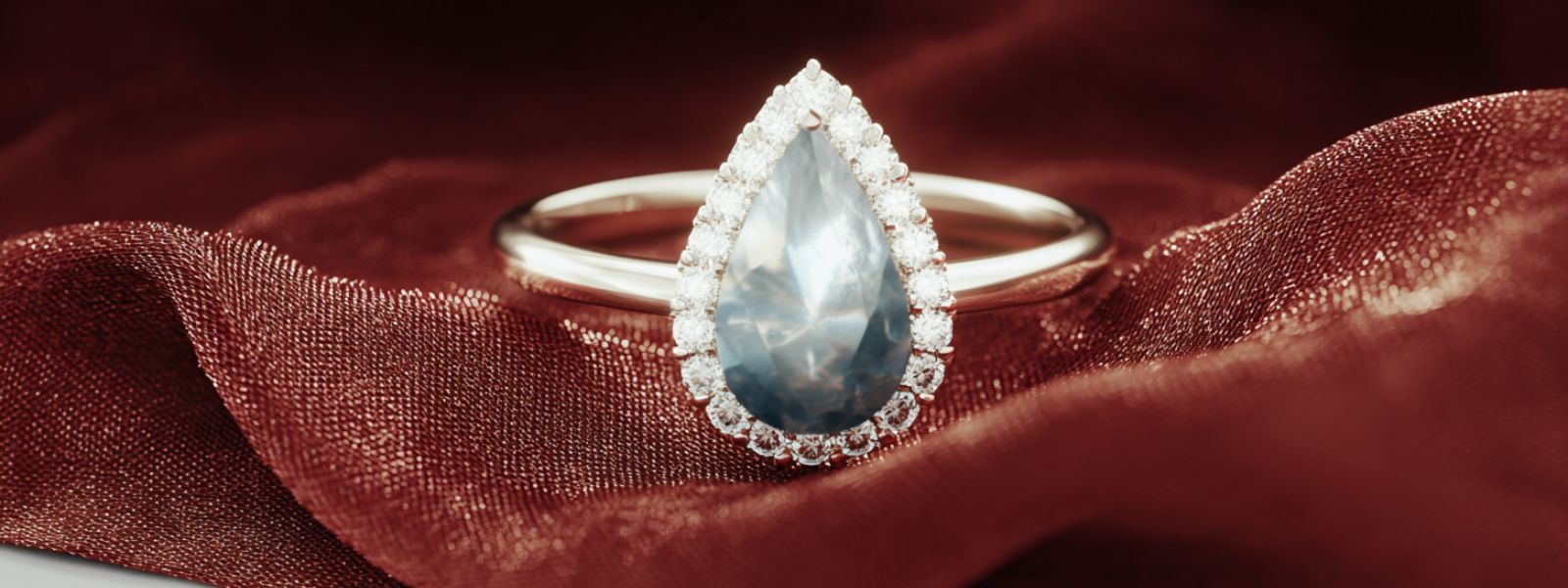
Learning how to wear a pear-shaped ring the right way can honestly be a game-changer, because this stone does not just sit on your finger; it commands attention. That iconic teardrop silhouette, pointed at one end and elegantly curved at the other, strikes that rare balance between timeless romance and fresh, modern style. And here is the best part: it is way more versatile than most people give it credit for.
Whether you just said yes to a stunning pear-cut engagement ring, are treating yourself to something special, or are simply doing your homework before making a decision, you have come to the right place.
In this guide, we are breaking down everything — which direction to point the stone, how to stack it with bands, how to stop it from spinning on your finger, and what to look for when you shop. By the time you are done reading, you will feel like a total pro every single time you glance down at your hand.
Table of contents
Which Direction Should the Point Face?
This is the question almost every pear ring owner asks first, and the honest answer is that there is no single rule. That said, here is how most people wear them and why.
Point toward the fingertip (traditional)
Orienting the pointed tip toward your nail is the most common approach. It creates a natural upward line that visually elongates the finger, and it is how pear rings tend to be photographed and displayed. If you love a classic, refined look, this is a great starting point.
Point toward the wrist (fashion-forward)
Turning the point inward toward your palm is less conventional but increasingly popular. Some wearers love the symbolism of the diamond pointing toward their heart. Others simply prefer how it looks with a particular band or on their specific hand shape. It reads as more unexpected and directional.
At an angle
Some east-west and tilted settings are specifically designed to orient the pear diagonally across the finger. This is a bold, modern choice that stands out in any crowd. If your setting was made for a specific orientation, that design intention is worth honoring — but for standard solitaires, feel free to experiment.
Our advice: Try all three positions before you decide. Hold your hand naturally at your side, then lift it as you would to show someone the ring. See which orientation catches the light and feels most natural to you.

How to Keep Your Pear-Shaped Ring From Spinning?
Because the pear shape is asymmetrical and longer than it is wide, it has a tendency to rotate on the finger, especially on slender fingers. This is one of the most practical things to address early, and there are several good solutions.
Get the right size: A ring that fits snugly at the knuckle but comfortably at the base is less likely to spin. If your knuckles are significantly larger than the base of your finger, talk to us about sizing beads, tiny metal balls added inside the band that create gentle resistance without making the ring tighter to put on.
Choose a contoured or V-shaped band: When you wear your engagement ring with a fitted wedding band, the two rings support each other, and the pear stays in place much better than it would alone.
Consider a low-profile setting: Settings that sit closer to the finger and have a lower center of gravity tend to spin less than tall, elevated settings. Worth asking about when you shop.
Pairing Your Pear with a Wedding Band
The good news: pear-shaped rings pair beautifully with a wide variety of bands. The key is understanding how different shapes interact with your center stone.
1. Contour or Chevron Bands
These are the most popular choices. A contour band curves around the rounded base of the pear, hugging the stone and creating a cohesive, fitted silhouette. A chevron band forms a V-shape that can frame either the pointed or rounded side, depending on your preference. Both give the ring a finished, intentional look.
2. Straight Bands
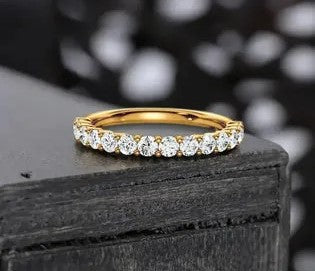
A simple, straight band, especially a slim one, works well if you want a cleaner, more minimal look. It will sit with a small gap at the base of the pear due to the shape, which some people find appealingly casual. A pavé straight band adds sparkle without complexity.
3. Stacking Multiple Bands
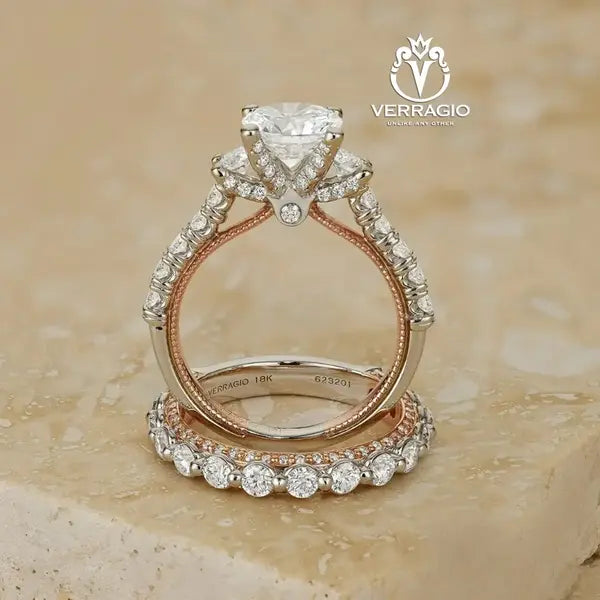
Pear engagement rings stack beautifully. Many of our clients wear the pear with one curved band on either side, or with a mix of slim straight bands above and below. Because the pear is a strong visual anchor, you can layer with confidence that it will not get lost in the stack.
A note on order: Tradition places the wedding band closest to the heart (innermost on the finger), with the engagement ring above it. That said, many people reverse this or wear both on the same hand without worrying about order. Do what looks right to you.
What to Look for When Choosing a Pear-Shaped Diamond?
Not all pear-shaped diamonds are created equal. Here are the details that matter most — in plain language.
Symmetry
Both curved sides of the pear should mirror each other evenly. If one side bulges more than the other, or if the tip is off-center, the stone will look off on the finger even if you cannot immediately identify why. Symmetry is the single biggest factor in whether a pear looks polished or slightly awkward.
The Bowtie Effect
Most pear-shaped diamonds show some degree of a "bowtie," a darker shadow across the center of the stone caused by the way light travels through the facets. A little bit is normal and even adds depth. A pronounced bowtie, however, will make the stone look dull in the middle. Ask to see the stone in different lighting conditions, not just under a jeweler's bright loupe.
Length-to-Width Ratio
This ratio determines whether your pear looks long and slender or shorter and rounder. A ratio around 1.45 to 1.75 is considered balanced by most standards, but what matters is what looks right to your eye on your hand. We have seen clients fall in love with pears outside that range entirely.
Tip Protection
The pointed end of a pear is the most vulnerable part of the stone. Make sure your setting includes a secure prong, ideally a V-prong or claw over the tip, or a partial bezel that wraps around that area. A protected tip means you can wear your ring confidently through everyday life without worrying about chips.

What Does a Pear-Shaped Ring Symbolize?
This is a question we hear often, and we love it. The pear shape sits at the intersection of two classic diamond cuts, the round and the marquise, which gives it a quality of balance, of holding two things together at once.
Many couples are drawn to the teardrop form for its sense of movement: it has a direction, a sense of going somewhere. Others love the softness of the round end paired with the decisiveness of the point. And some simply love the way it looks.
Whatever meaning you bring to it is the right one. A ring is most powerful when it feels like yours.
Find Your Pear at Miro Jewelers
Reading about pear-shaped rings is one thing; seeing them on your hand is another. At Miro Jewelers, we carry a curated selection of pear-shaped and other-shaped engagement rings in a range of settings, metals, and styles, from sleek solitaires to vintage-inspired halos, and we love helping clients find the one that feels exactly right.
When you visit, we will put different orientations, bands, and stacks in front of you so you can see in real life what you have been imagining. Bring your questions, your inspiration photos, and your instincts. We will take it from there.
Visit us in store or reach out at info@mirojewelers.com or call +1-303-393-8881—we are here to help.


