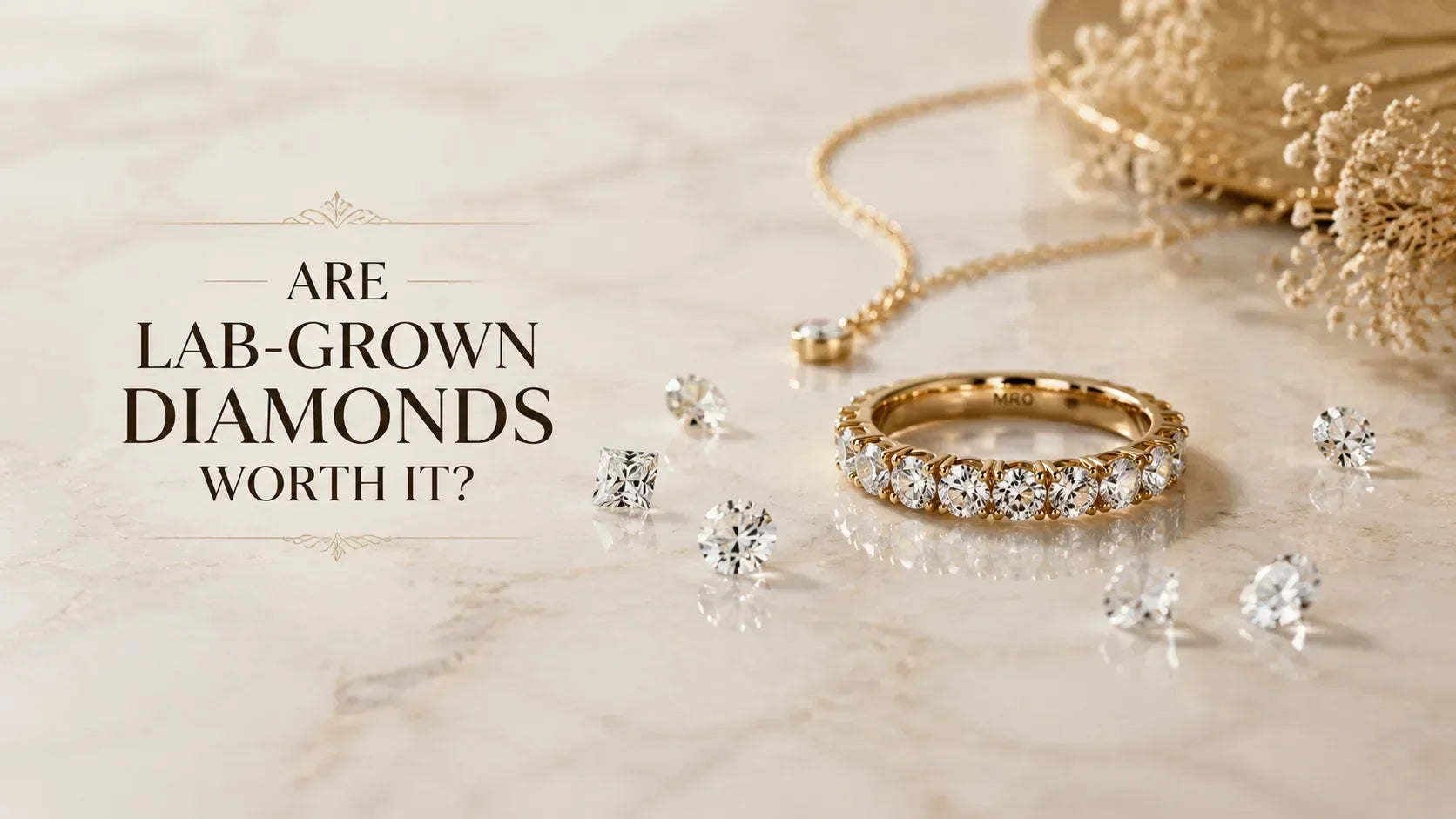
Are Lab-Grown Diamonds Worth It?
If you've started ring shopping, you've probably asked yourself one honest question. Are lab-grown diamonds worth it?
For most couples, yes. You get the same brilliance, the same hardness, and the same certified grading as a mined stone, usually for 30 to 40 percent less. That's a bigger stone for the same money, or a better stone for the same money. Your call.
We set lab-grown diamonds in our Centennial studio every day, so this is the same straight advice we give couples across the counter. Here's what you're actually buying, what you save, and when a lab-grown stone is the right pick for your engagement ring.
Explore Our Collections
Table of contents
A Lab-Grown Diamond Is a Real Diamond
Let's clear this up first. A lab-grown diamond is a diamond. Same carbon structure, same sparkle, chemically, physically, and optically identical to a mined one. You can't spot the difference by eye. Neither can your future mother-in-law.
The only thing that's different is where it came from. One grows in a lab over a few weeks. The other took a billion years underground.
Durability is a tie, too. Lab-grown diamonds hit a perfect 10 on the Mohs hardness scale, so they shrug off scratches and daily wear exactly the way mined stones do. And every lab-grown diamond we sell is graded by the GIA or IGI against the same 4Cs. You get the same independent report you'd expect from a natural diamond. Nothing watered down.
What You Actually Save
Here's where it gets interesting.
You'll usually pay 30 to 40 percent less than a natural diamond with a comparable cut, color, and clarity. On a center stone, that gap is the difference between a one-carat look and a two-carat look. Or between nice clarity and the kind that stops people mid-sentence.
That's the real appeal. Most of our couples spend the savings in one of two ways. They size up to a noticeably bigger stone, or they put the difference into a finer setting, a wedding band, or the honeymoon. Either way, you're buying more of what you actually care about.
Still working out your number? Start with our guide on how much to spend on an engagement ring.

Do Lab-Grown Diamonds Hold Their Value?
Most articles dodge this one. We won't.
Lab-grown diamonds aren't an investment. Neither are most natural diamonds bought at retail. Resale on any diamond is a fraction of what you paid, so if you're buying to flip it later, skip diamonds entirely. Buy something else.
The value here is the kind you wear. A well-cut lab-grown diamond gives you a certified, brilliant stone and decades of meaning on your hand. For an engagement ring, that's the return people are actually after. Not a resale number.

Will It Still Look Good in Twenty Years?
Yes. And this one trips people up, so let's say it plainly.
Because the hardness and the optical properties are identical, a lab-grown diamond ages exactly like a mined one. It won't cloud. It won't yellow. It won't lose its fire. There's no coating to wear off, because there's no coating at all. It's a diamond all the way through.
Keep up with routine cleaning and get the prongs checked now and then, which we handle free for the life of the ring, and your stone will look as bright as the day you said yes.
When a Natural Diamond Is the Better Call
We'd rather sell you the right stone than the popular one.
If the billion-year origin story genuinely means something to you, or you want a stone tied to natural rarity, a natural diamond is going to feel more meaningful. That's a real reason, not a marketing one.
Come in, and we'll put both in front of you under the same light. Let the stone win you over.
Want the point-by-point breakdown? We covered it in lab-grown vs natural diamonds. And if you're weighing a third option, here's moissanite vs lab diamond.
The Miro Jewelers Difference
You're not picking a ring off a shelf here.
Our in-house designers build custom engagement rings with you, from the first sketch to the final hand-set stone. Pick a loose lab-grown diamond in round, oval, cushion, princess, emerald, radiant, or pear, and we'll show you line-by-line pricing before you commit to anything.
Every piece comes with our lifetime warranty. Free cleanings, free inspections, and free resizing at our Centennial studio. Financing is available. And consultations are always no-pressure, whether you come in or hop on a video call.
Frequently Asked Questions
Are Lab-Grown Diamonds Real Diamonds?
Yes. Same composition, same hardness, same look, and they're graded by the same labs.
How Much Cheaper Are Lab-Grown Diamonds?
Figure 30 to 40 percent less than a comparable natural diamond. That usually buys you a bigger or better stone.
Will a Lab-Grown Diamond Last a Lifetime?
Absolutely. It's a 10 on the Mohs scale, so it handles everyday wear for generations.
Can a Jeweler Tell the Difference?
Not by eye, and not with a loupe. It takes specialized lab equipment. Your grading report will tell you which one you have.
Do Lab-Grown Diamonds Get Cloudy Over Time?
No. That's a myth. Diamond doesn't cloud, and lab-grown is diamond.
The Bottom Line
So, should you go lab-grown?
If you want a certified, seriously sparkly diamond and more stone for your money, it's an easy yes.
Come see our lab-grown collection in person at our Centennial studio. Book a consultation or browse loose diamonds online first. Then let's design something that's unmistakably yours.